

A few months ago, a patient in her early 40s came into my Etobicoke office holding her lower back and wincing with every step. She worked at a desk most of the day, and for weeks she had felt a dull ache in her lower back that traveled down the back of her right leg. Some mornings it was a mild tightness. Other days it felt like a hot wire running from her buttock down to her calf, especially after a long stretch of sitting. She had read online that this might mean she needed surgery, and she was frightened to move.
I hear versions of this story often. Sciatica is one of the most common reasons people come to see me, and it is also one of the most misunderstood. So let us walk through what sciatica actually is, what causes it, when it needs urgent medical attention, and what conservative Chiropractic care can realistically offer.
What Sciatica Actually Is
Sciatica is not a diagnosis on its own. It is a symptom, a pattern of pain that travels along the path of the sciatic nerve, usually starting in the lower back or buttock and radiating down one leg. The proper clinical term is lumbosacral radiculopathy, which simply means a nerve root in the lower spine, most often at the L5 or S1 level, is being irritated or compressed as it exits the spine.
Think of the nerve root like a garden hose passing through a narrow gap in a fence. If something presses against that gap, whether it is swelling, a bulging disc, or a tightened muscle nearby, the flow through the hose becomes restricted, and the whole length of it can react. That is why someone can feel pain, numbness, or tingling far from where the actual irritation is happening, all the way down into the calf or foot.
According to Mayo Clinic, sciatica typically affects only one side of the body and can include burning pain, numbness, tingling, or muscle weakness along the leg. Research compiled by the National Institutes of Health suggests that between 10 and 40% of people experience sciatica at some point, with the highest incidence in people in their forties. If you have felt that shooting sensation while sitting at your desk or lifting your child out of a crib, you are far from alone.
What Causes Sciatica
In most cases, sciatica traces back to something happening in the lower spine that puts pressure on a nerve root. The most common causes I see in my Etobicoke practice include the following.
- Disc herniation or bulge. By far the most frequent cause, responsible for roughly 90% of sciatica cases according to research published in the National Library of Medicine. The soft inner material of a spinal disc pushes outward and irritates a nearby nerve root.
- Spinal stenosis. A narrowing of the spinal canal, often related to age, that reduces the space available for nerve roots.
- One vertebra slips forward over the one below it, which can pinch a nerve root along the way.
- Piriformis syndrome. A deep buttock muscle sits close to the sciatic nerve and can mimic true nerve root sciatica when tight or irritated, though Cleveland Clinic notes this is a less common cause.
- Postural changes, pelvic shifting, and added mechanical load can irritate the sciatic nerve, which is one reason I see this often in the pregnant patients I care for.
Risk factors include prolonged sitting, occupations involving repeated twisting or heavy lifting, higher body weight, and a sedentary lifestyle, according to Mayo Clinic. None of these guarantee sciatica will develop, but they add stress to a spine that may already be managing other demands.
Red Flags: When Sciatica Is an Emergency
This is the part of sciatica I want every patient to understand clearly, because most sciatica is not dangerous, but a small percentage of cases are.
If you experience any of the following, please go to the emergency room immediately. These can be signs of a rare but serious condition called cauda equina syndrome, where nerve roots at the base of the spine become severely compressed, requiring urgent evaluation because waiting can risk permanent nerve damage.
- New loss of bladder or bowel control, or sudden difficulty starting or stopping urination
- Numbness in the groin, inner thighs, or buttocks, often described as feeling like sitting on a saddle
- Weakness or numbness in both legs at the same time
- Rapidly worsening leg weakness or a foot that suddenly feels like it is dragging
- Sudden loss of sexual sensation or function
According to Cleveland Clinic, cauda equina syndrome is rare, affecting an estimated 1 in 30,000 to 100,000 people per year. Rare does not mean impossible, and I would rather every patient know these signs than dismiss something serious as ordinary sciatica.
A few other situations deserve prompt medical evaluation too, including sciatica following a significant fall, sciatica with unexplained weight loss or a history of cancer, and sciatica paired with fever or signs of infection. If any of this describes your situation, please see your family physician promptly, and I will always help coordinate that care if you come to see me first.
How I Assess Sciatica
When a patient comes to me with suspected sciatica, I start with a thorough history and physical examination. I check posture, examine the spine for subluxations/misalignments, and I often use a test called the straight leg raise, gently lifting the leg while the patient lies on their back. If that movement reproduces the radiating pain, it helps confirm a nerve root is involved rather than a more localized muscular issue.
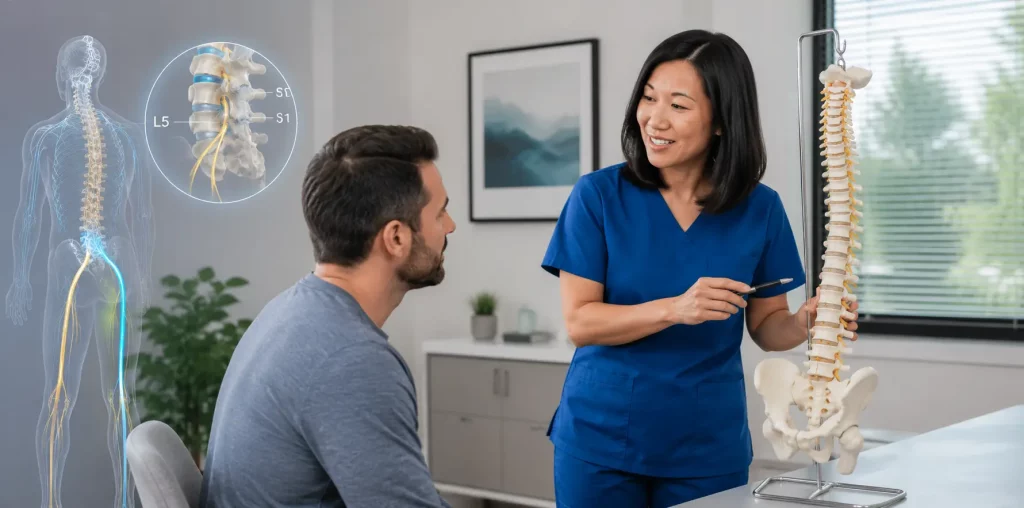
After performing the examination, X-ray imaging is most often done to analyze the overall alignment and condition of the spine to understand its impact on nerve function. Patients are often surprised that I do not refer them to their MD for an MRI right away. Current guidance from the American Academy of Family Physicians recommends holding off on imaging for the first six weeks unless red flag symptoms are present, since most sciatica improves substantially within that window and early imaging can reveal age-related disc changes unrelated to the actual pain. If your presentation includes any red flags, or you are not improving as expected, I will refer you for imaging or to your physician without hesitation.
Conservative and Chiropractic Care, What the Evidence Says
I want to be honest about what the evidence actually shows, because overpromising helps no one.
The Canadian Chiropractic Guideline Initiative and the National Institute for Health and Care Excellence both support a combination approach centered on staying active and incorporating targeted exercise, with manual therapy such as spinal manipulation considered as part of that broader plan rather than a standalone fix. A 2025 review published in the Journal of Orthopedic and Sports Physical Therapy found spinal adjustments and guided exercise among the approaches linked to meaningful short-term reductions in leg pain, though the researchers noted the overall certainty of this evidence remains low. I share this because I believe patients deserve a realistic picture, not a promised cure.
In my practice, this usually means gentle, targeted adjustments to reduce nerve irritation and improve movement, paired with specific exercises you can do between visits. For pregnant patients, I often use the Webster Technique to address pelvic alignment, which can ease the mechanical strain contributing to their symptoms. Staying appropriately active, rather than resting completely, tends to support recovery better than prolonged inactivity.
What Recovery Realistically Looks Like
Most people with sciatica improve meaningfully within about six weeks, and most see substantial resolution within twelve weeks with conservative care, according to research summarized by the American Academy of Family Physicians. Symptoms persisting beyond twelve weeks are considered chronic sciatica, which may call for further imaging or a referral to a specialist. Surgery is generally reserved for progressive neurological decline, unrelenting symptoms that do not respond over time, or the emergency red flags described earlier.
The patient I mentioned at the start is a good example of how this usually unfolds. Her symptoms had been building for weeks before one afternoon of sitting made them impossible to ignore. There was no single dramatic injury, just a spine under quiet stress for some time. After a thorough assessment ruled out any red flags, we worked through a combination of Chiropractic care and specific movement strategies. Within several weeks, her radiating leg pain had settled considerably, and she was back to her normal routine with a clearer sense of how to protect her back going forward.
Putting It All Together
Sciatica can feel frightening, especially when the pain travels somewhere unexpected like your calf or foot. In most cases, it is manageable and responds well to time, movement, and appropriate conservative care. The most important thing is knowing the difference between ordinary sciatica and the rare red flag symptoms that need emergency attention.
If you are dealing with radiating leg pain and want a thorough assessment, I would be glad to help. Learn more on our Sciatica page or read about what to expect during your first visit. When you are ready, you can book an appointment with our Etobicoke clinic.
Frequently Asked Questions
Can a Chiropractor help with sciatica?
Yes, for many people. Care typically involves gentle adjustments and targeted exercise, though results vary and evidence for manual therapy is still considered limited in certainty.
How long does sciatica usually last?
Most cases improve substantially within about six weeks and continue resolving over the following months. Sciatica lasting beyond twelve weeks is generally considered chronic and may need further evaluation.
Should I keep walking if I have sciatica?
Generally, yes. Staying appropriately active tends to support recovery better than prolonged bed rest, though it is worth easing in gradually and listening to your body.
Is heat or ice better for sciatica?
Both can help. Some find ice more soothing early on, while heat relaxes surrounding muscles later. It often comes down to what feels best for you.
When should I go to the emergency room for sciatica?
Go immediately for new loss of bladder or bowel control, numbness in the groin or inner thighs, weakness in both legs, or rapidly worsening leg weakness. These can indicate a rare but serious condition requiring urgent care.
Do I need an MRI for sciatica?
Not usually, at least not right away. Guidance generally supports waiting about six weeks before imaging unless red flag symptoms are present, since most sciatica improves within that window.
Is sciatica the same as a pinched nerve?
They are closely related. Sciatica describes the pattern of radiating pain, while a pinched nerve, or nerve root compression, is often the underlying cause.
Can sciatica go away on its own?
Often, yes, particularly when the cause is mild irritation rather than significant compression. A proper assessment still helps rule out red flags and guide a faster recovery.
This post is intended for educational purposes and does not replace individualized medical advice. If you are experiencing any red flag symptoms described above, please seek emergency care immediately.