
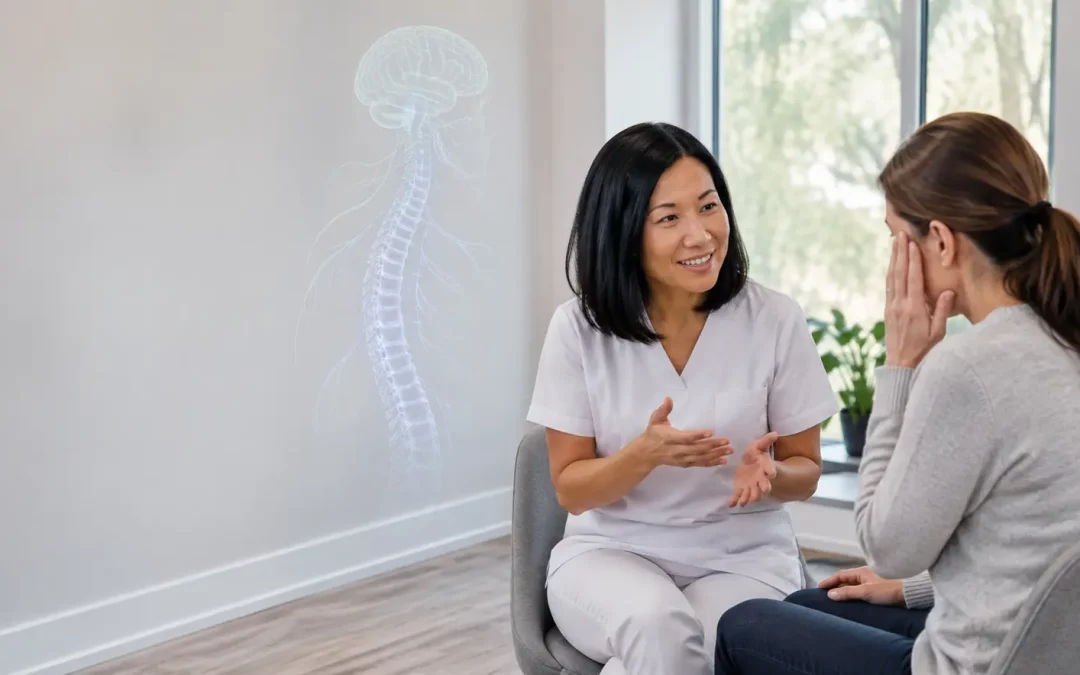
Last month, a patient came in to see me for what she described as chronic neck pain and tension headaches. She was a teacher in her early forties, busy, stretched thin, running on not enough sleep. Before I even began the assessment, she said something I have heard in different forms many times since: “I know you fix spines. But honestly, I think my stress is causing all of this.”
She was more right than she realized.
Over the next several weeks of Chiropractic care, her neck pain improved significantly. But what she kept mentioning in our visits was something she had not expected. She was sleeping better and felt less wound up by Friday afternoons. The low-level anxiety that had been her baseline for years had softened. She asked me one day if that was normal, or if she was imagining it.
I told her she was not imagining it at all. And I want to use this post to explain why: it is a question I hear often in my Etobicoke practice, and the answer matters to many people dealing with both physical tension and the emotional weight of modern life.
The Body Does Not Separate Physical and Emotional Stress
Your body does not distinguish between physical stress and emotional stress at the level of the nervous system. Both activate the same fundamental pathway: the sympathetic nervous system, commonly known as the fight-or-flight system.
When you are under sustained psychological stress, whether from work pressure, financial anxiety, family demands, or the general pace of life in a place like Etobicoke, your sympathetic nervous system maintains a chronically elevated state. Heart rate stays slightly elevated, breathing becomes shallower, and muscles, especially those of the neck, jaw, and shoulders, hold residual tension. Cortisol, the primary stress hormone, circulates at levels above optimal. The parasympathetic system, the branch responsible for rest, recovery, and digestion, is suppressed.
Research published in PMC by the National Library of Medicine confirms that the majority of symptoms associated with anxiety and chronic stress, including elevated cortisol, elevated adrenaline, insomnia, agitation, and muscle tension, can be traced to overactivation of the sympathetic nervous system. The paper specifically examines how Chiropractic adjustments may help regulate this autonomic imbalance by activating the parasympathetic system to counterbalance sympathetic dominance.
That is the foundation of the connection between Chiropractic care and stress relief. It is not about relaxation in a general sense. It is about a specific neurological mechanism.
What the Spine Has to Do With Stress and Anxiety
The spine houses and protects the spinal cord, which is the primary communication pathway between the brain and the rest of the body. When areas of the spine become restricted or misaligned, what Chiropractors call vertebral subluxations, those restrictions create interference in the neural signals traveling through and around those segments.
Here is what is clinically significant about that interference in the context of stress and anxiety. The spine also houses the pathways of the autonomic nervous system, including the sympathetic chain ganglia that run along the thoracic spine. When there is sustained mechanical dysfunction in the thoracic or cervical spine, it can contribute to a low-level, chronic irritation of sympathetic neural pathways. The body stays in a mildly activated state not only because of the psychological stressors it is managing, but also because the mechanical environment of the spine reinforces that activation.
This bidirectional relationship is something I see clinically all the time. Stress causes muscle tension and altered breathing mechanics, which create spinal dysfunction. Spinal dysfunction irritates sympathetic pathways, which amplifies the stress response. The two feed each other, and breaking that cycle requires addressing both the structural and physiological components.
What the Research Actually Shows
Chiropractic care is not a treatment for anxiety disorders. It is not a replacement for psychological support, therapy, or medication where those are warranted. What the evidence does support is something more nuanced and genuinely useful.
A case study published in the Journal of Contemporary Chiropractic documented measurable reductions in salivary cortisol levels and self-reported anxiety in a patient receiving Chiropractic care for neck pain and headaches. The reduction in the primary stress hormone cortisol was a direct outcome of spinal management, not a separate intervention.
A study published in the Journal of Manipulative and Physiological Therapeutics found that Chiropractic adjustments significantly improved heart rate variability (HRV), a well-established physiological marker of autonomic nervous system health and stress resilience. Higher HRV is associated with better capacity to regulate emotional responses, lower anxiety levels, and greater physiological flexibility in response to stressors.
Research published in Frontiers in Neuroscience suggests that spinal manipulation can stimulate neuroplastic changes in the brain, including in the prefrontal cortex, the region responsible for emotional regulation, executive function, and modulation of the stress response. When the prefrontal cortex functions better, the brain is better able to regulate the fear and anxiety circuits that drive chronic stress.
A 2024 study published in Brain Sciences tracked 76 people with chronic lower back pain over four weeks of Chiropractic care and found significant improvements not only in pain but also in mood and quality-of-life measures. The EEG recordings taken before and after the intervention showed measurable changes in brain activity patterns, suggesting that the neurological effects of Chiropractic care extend well beyond the treated spinal segment.
The HPA Axis, Cortisol, and the Chiropractic Adjustment
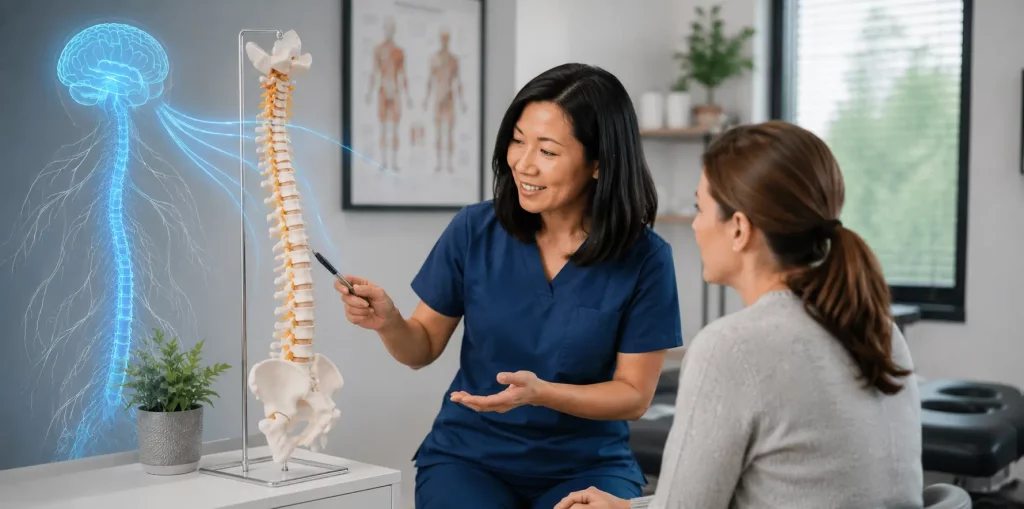
When a Chiropractic adjustment is delivered to a restricted spinal joint, the mechanoreceptors embedded in the joint capsule and surrounding ligaments fire rapidly, sending a strong proprioceptive signal up the spinal cord to the brain. That signal is received by the hypothalamus, the brain region that serves as the central interface between the nervous and endocrine systems. The hypothalamus, receiving better quality sensory information from the adjusted segment, modifies its signaling to the pituitary gland, which in turn influences the activity of the adrenal glands.
The adrenal glands produce cortisol in response to stress signals from the brain. When the hypothalamus-pituitary-adrenal (HPA) axis functions with higher-quality input from the spine, it regulates cortisol production more accurately. The adrenal glands are less likely to overproduce cortisol in response to the same set of stressors. The result is a measurable reduction in the body’s physiological stress response.
This is why the patient I described at the beginning of this post noticed improvements in her baseline anxiety alongside improvements in her neck pain. Her spine was not separate from her nervous system’s stress load. It was contributing to it. Addressing the spinal component allowed the system as a whole to recalibrate.
What I See in Practice with Anxious Patients in Etobicoke
Life in Etobicoke is genuinely demanding and full of various stressors. I see professionals managing hybrid work schedules and long commutes along the Queensway and Highway 427. I see parents running children to hockey at the local arenas and managing school schedules alongside their own careers. I see people who have normalized a level of daily tension and low-grade anxiety that they no longer even recognize as optional.
What I notice consistently is that patients who are carrying significant stress loads tend to present with predictable physical patterns. The upper trapezius and levator scapulae are chronically tight. The cervical spine shows restriction, especially at the C1-C2 and C4-C5 levels. The thoracic spine is often compressed and restricted in extension. Breathing mechanics are shallow, with poor diaphragmatic excursion and overuse of the accessory neck and shoulder muscles for respiration.
Each of these physical findings is both a consequence of chronic stress and a contributor to it. Tight upper traps amplify the sense of tension throughout the head, neck, and jaw. Restricted cervical segments reduce proprioceptive input to the brain, impairing its ability to regulate calmly. Shallow breathing maintains sympathetic dominance by preventing the full diaphragmatic excursion that would otherwise activate the parasympathetic vagal response.
When I treat these patients with Chiropractic adjustments targeting the restricted cervical and thoracic segments, this is helping to interrupt the physical side of their stress loop. Many of them describe a notable shift in how they feel after adjustments, a release of physical tension that carries into their emotional state as well. This is consistent with the research on autonomic regulation and entirely predictable from the anatomy.
What Chiropractic Care Does Not Replace
If you are dealing with significant anxiety, panic disorder, generalized anxiety disorder, or depression, please seek support from a qualified mental health professional. Chiropractic care can be a genuinely useful adjunct to that support, and it may reduce the physiological burden that anxiety places on the body. But it is not a substitute for psychological treatment or, where clinically indicated, appropriate medication.
Chiropractic care is a physical complement to whatever other support you are currently receiving. Reducing the mechanical load on the sympathetic nervous system, improving HRV, lowering baseline cortisol, and providing better proprioceptive input to the brain’s regulatory centers all make the other components of your care work better. A nervous system that is less mechanically burdened responds better to everything else you are doing for your health.
Taking the First Step
If you have been managing stress and anxiety in Etobicoke and you have noticed that it expresses itself physically in your neck, shoulders, jaw, or back, I can take a look at what is happening in your spine and nervous system and what we can do to improve your health.
A thorough assessment at Clarity Wellness Chiropractic will give us a clear picture of where your spine is carrying dysfunction and how your nervous system is responding. From there, we can build a care plan that addresses the physical side of your stress load and creates the conditions your body needs to find a calmer, more regulated baseline.
Book your appointment today and take the first step toward greater healing.